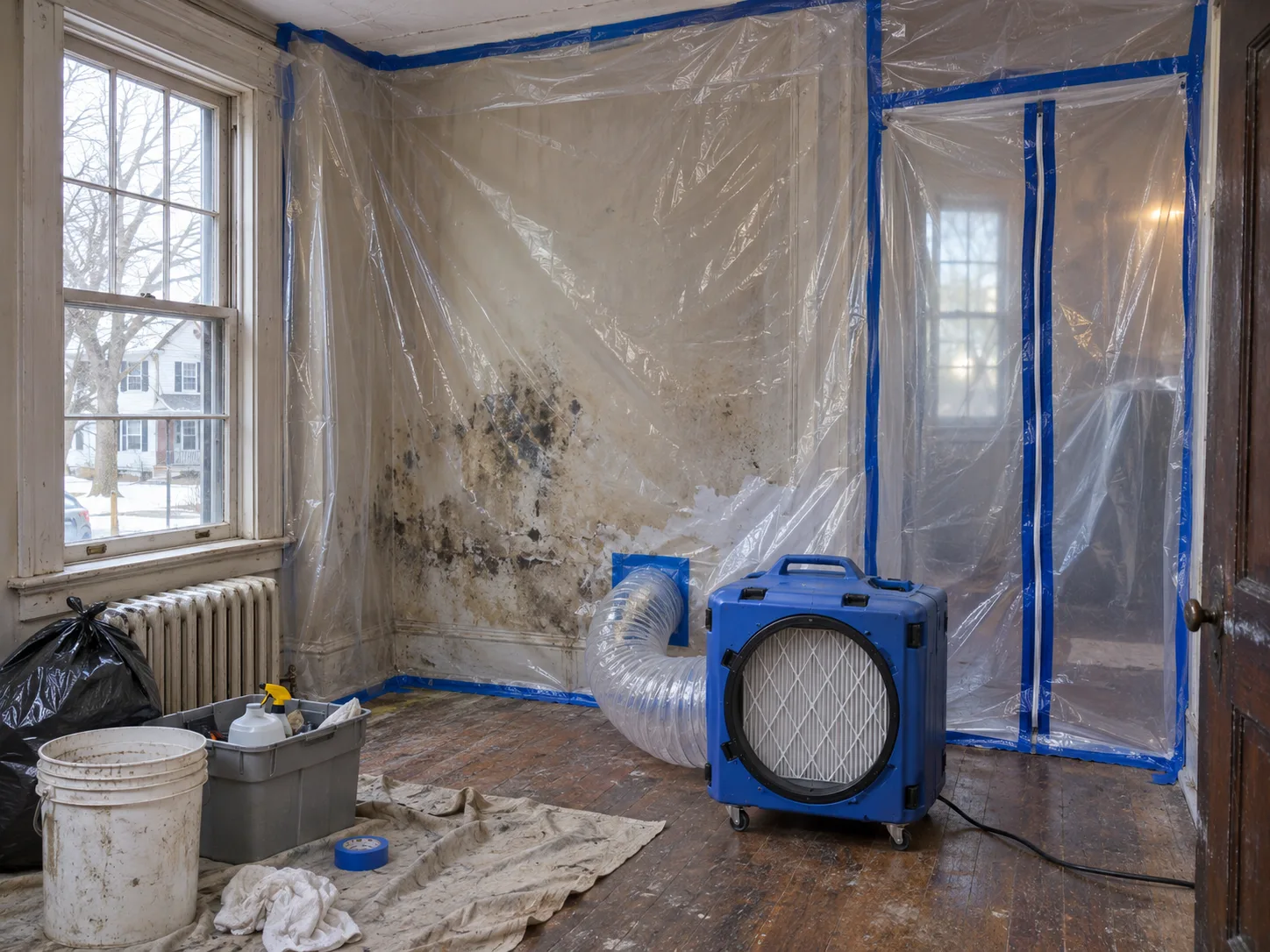
Mold starts on wet drywall, insulation and wood framing inside 48 to 72 hours of a water event. In Keene the problem compounds because 1800s and early 1900s homes in Harrisville, Marlborough and Westmoreland sit on granite-rubble foundations that hold humidity year-round, so a basement never fully dries to typical standards. We see mold calls two ways: as a follow-up to a water damage job we didn't do, where a homeowner found black staining behind drywall a week after a flood, and as a standalone call on a persistently damp basement in a Monadnock Region farmhouse where the humidity has been slowly feeding mold for years.
The scope depends on what's growing and where. Surface mold on paint, non-porous surfaces like tile and sealed concrete, and sealed wood framing can usually be HEPA-vacuumed and treated with an EPA-registered antimicrobial. Mold on porous materials, drywall, cellulose and fiberglass insulation, carpet and pad, cardboard storage, has to come out. There's no spray-on sealant that beats mold on drywall, period, despite what the big-box store sells. Visible mold over 10 square feet also triggers containment protocol: 6-mil plastic walls, a HEPA-filtered negative air machine, and PPE for the crew. Most Keene basement mold jobs come in at 10 to 50 square feet of affected drywall and insulation.
The housing stock drives repeat calls. Downtown Keene apartments in late-1800s brick buildings with original plaster have decades of water staining, and the paint sometimes hides active mold growth behind it. Keene State College area 1960s ranches with finished basements built on uninsulated concrete floors hold condensation six months a year. Jaffrey's post-2000 slab-on-grade builds are less of a mold problem until a plumbing failure hits, but they go downhill fast when they do because modern air-tight construction traps humidity. We write the scope to the specific house, not a template.
Insurance on mold is where homeowners get caught. Most New Hampshire policies cover mold only when it's a direct result of a covered water loss, like a burst pipe, and usually only up to a sub-limit, often $5,000 or $10,000. Mold that grew from a long-term leak, from groundwater, or from poor ventilation isn't covered. We document when the mold likely started based on growth pattern and water source so the adjuster has a clear story. Post-remediation we provide moisture readings and a written clearance note; third-party air clearance testing is a separate scope through an independent industrial hygienist if your adjuster or a sale requires it.
What we handle
Basement Mold Remediation
The most common mold call in Keene and the Monadnock Region. Containment, drywall and insulation removal to clean framing, HEPA vacuum, antimicrobial treatment, and dry-down to sustainable humidity.
Mold Remediation After a Burst Pipe
Mold that started on the drywall and framing behind a wall where a copper line ruptured in January. Common in exterior walls of older Keene and Marlborough homes. Covered by most NH homeowners policies up to the mold sub-limit.
Crawl Space Mold Removal
Mold on joists, subflooring and vapor barriers under 1800s Harrisville and Westmoreland farmhouses. HEPA vacuum, antimicrobial, new vapor barrier if the old one is lost.
Attic Mold Remediation
Roof leak mold on sheathing and attic framing. Common in older Downtown Keene homes where original roof decking saw years of ice dam damage before the roof was replaced.
Post-Remediation Moisture Verification
Written moisture readings on all remediated surfaces before any wall closes back up. Independent air clearance testing available through a third-party industrial hygienist when required by insurance or a real estate transaction.
Emergency Mold Response After Water Damage
Called in after another contractor's water job left wet framing and the mold started. We scope, contain and remediate without re-doing the water work if it was done correctly.
How the job goes
1. On-Site Inspection
Visible mold mapped and measured, moisture meter on all adjacent framing, water source identified. You get a written scope and price in 24 hours, same-day for emergency calls.
2. Containment Setup
For any job over 10 square feet, 6-mil plastic containment walls, HEPA-filtered negative air machine, and HEPA-filtered air scrubber running through the job. Zippered entry, PPE on the crew.
3. Removal and HEPA Vacuum
Affected drywall and insulation cut back a foot past visible mold and bagged inside containment. Framing HEPA-vacuumed, then wiped down. Removal takes 1 to 3 days depending on the room.
4. Antimicrobial Treatment and Dry-Down
EPA-registered antimicrobial applied to all remediated surfaces. Dehumidifier runs until the space hits sustainable humidity, usually 1 to 2 days. Final moisture readings written on the job sheet.
5. Rebuild and Clearance
Drywall and insulation replaced if you want one crew through the whole job. Written clearance note with moisture readings handed to you. Third-party air clearance test coordinated through an independent industrial hygienist if required.
What's included
- On-site inspection with moisture meter and mold mapping
- Written scope and price before any work starts
- Containment on any job over 10 square feet
- HEPA-filtered negative air machine and air scrubber
- EPA-registered antimicrobial treatment
- Daily moisture readings on remediated surfaces
- Written clearance note with final readings
- Disposal of mold-contaminated materials in sealed bags
What it costs
Most Keene mold remediation jobs run $500-$3,000 per room depending on size, surface type and whether framing is affected.
| Job | Typical price | Notes |
|---|---|---|
| Small Mold Job (Under 10 Square Feet, Surface Only) | $500-$1,200 | No containment required by protocol. HEPA vacuum, antimicrobial treatment, surface cleaning only. |
| Standard Room Mold Remediation (10-50 Square Feet) | $1,500-$3,000 | Full containment, drywall and insulation removal, HEPA vacuum on framing, antimicrobial, dry-down. Most basement mold jobs land here. |
| Large Mold Remediation (50-100 Square Feet) | $3,000-$6,000 | Multiple walls or a whole-room scope. Containment, demo, framing treatment, dry-down, written clearance. |
| Crawl Space Mold Remediation | $2,000-$5,500 | Joist and subfloor treatment plus new vapor barrier. Older farmhouse crawl spaces with dirt floors run to the top. |
| Third-Party Air Clearance Test | $350-$750 | Through an independent industrial hygienist when required by insurance or a sale. Not included in standard remediation. |
| Free Phone Consult and Price Band | Free | Call, describe what you see, you get a likely scope and a price band before an inspection. |
Ranges are typical for Mold Remediation After Water Damage jobs in Keene and confirmed with an exact written quote before any work starts.