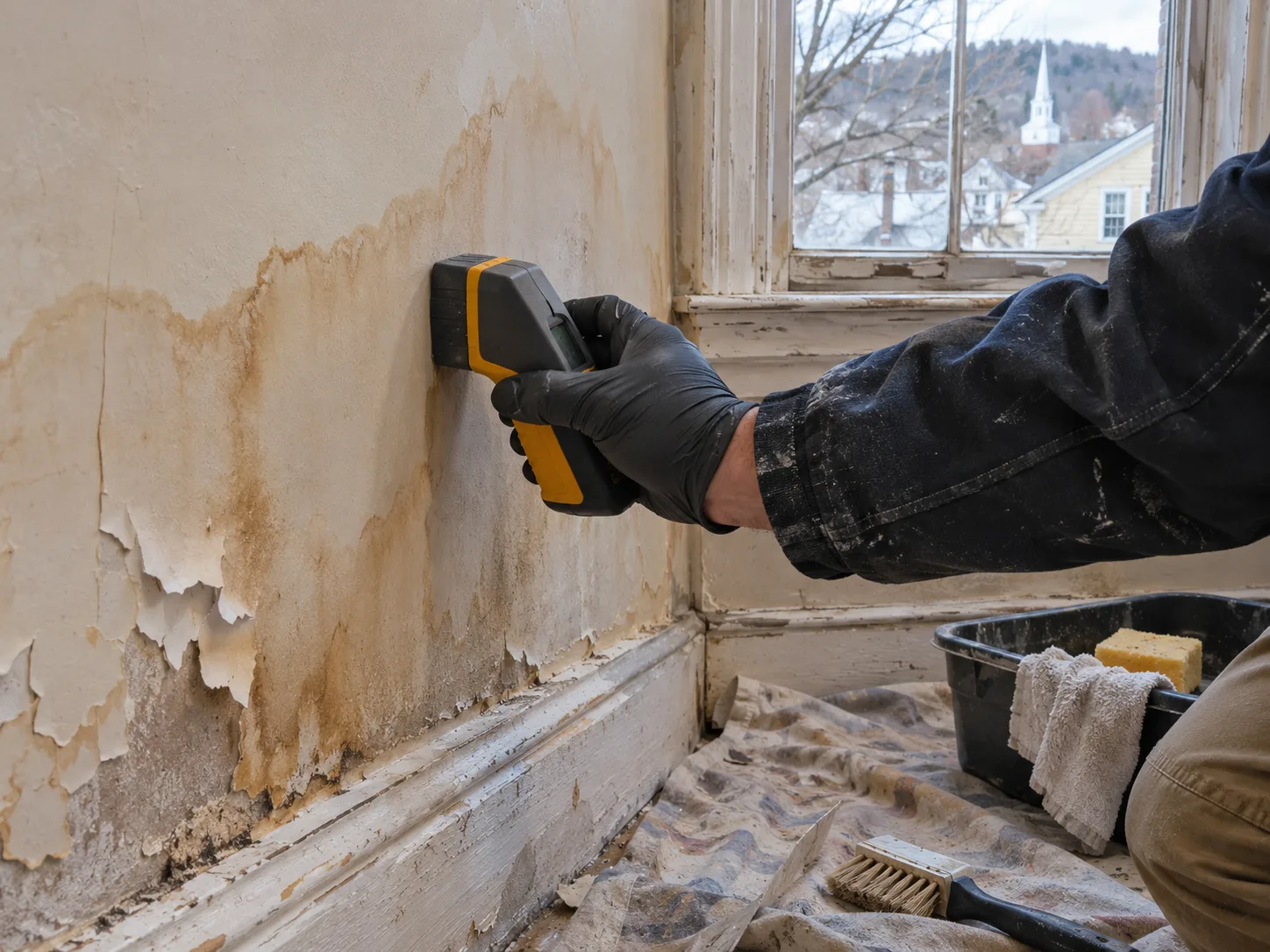
Most water damage calls in Keene fall into four patterns. Winter burst pipes in exterior walls when it hits -10°F and copper lets go behind drywall. Spring snowmelt driving groundwater and the Ashuelot River into basements across Swanzey, Winchester and the lower parts of West Keene. Summer thunderstorms dropping an inch of rain on an aging roof over a Downtown Keene apartment. And the year-round misery calls: failed washing machine hoses, dishwasher supply lines, failed sump pumps in Harrisville and Marlborough. We meter the walls and the subfloor with a Delmhorst pin meter and a Flir thermal camera on the first visit, not a flashlight, because wet framing behind dry-looking paint is where mold starts.
Keene's housing stock makes a real difference in how we scope a dryout. 1800s and early 1900s farmhouses in Harrisville, Westmoreland and Chesterfield sit on granite-rubble foundations that breathe moisture year-round, so we can't just dry a basement and walk away, we have to pull insulation off the sill and check the rim joist for rot. 1950s to 1970s ranches around the Keene State College area have plaster walls that hold water for days behind an intact surface. Post-2000 slab-on-grade builds in Jaffrey behave more like a modern home, but a deep flood into the subfloor can delaminate engineered flooring in 12 hours. We write the scope based on what's actually behind the surface.
The permits and insurance side matters in Cheshire County. Pure extraction and drying is unpermitted work. The rebuild side, drywall, insulation, electrical if an outlet got soaked, is permitted through the Keene building office or your town hall in Walpole, Chesterfield and Hinsdale. Most NH homeowners policies cover sudden and accidental water damage, so a burst pipe or a washer overflow is usually a covered claim. What they don't cover without a specific rider is sewer backup and surface flooding from a river event. If Ashuelot water came over a bank and into your basement, that's a flood policy question. We document the water source with photos and moisture maps on day one so the adjuster has what they need.
The mistake we see most from chase-the-cheapest contractors here is skipping the moisture meter and skipping the mold check. A big-box franchise crew will sometimes set six air movers in a flooded basement, bill five days, and never pull a reading or open a wall. Two weeks later you've got black mold behind the drywall where the insulation stayed wet. Our rule is simple: moisture readings every day of the dryout, written on the job sheet, and no wall closes back up until the meter reads below 15% on framing. That's how the work actually holds.
What we handle
Emergency Water Extraction
Truck-mounted water extraction for basements, crawl spaces and multi-room floods. Crew on site inside 90 minutes in Keene, pumping standing water the same hour we arrive to stop drywall and subfloor damage from spreading.
Structural Drying and Dehumidification
Commercial air movers and LGR dehumidifiers run 3 to 5 days with daily moisture monitoring on a job sheet. We dry framing, subfloor and salvageable drywall to below 15% before any wall closes back up.
Water Damage Insurance Claim Help
Full photo log, moisture readings and written scope formatted for your adjuster. We bill most NH carriers directly on covered claims and handle supplement requests when hidden damage opens up during demo.
Burst Pipe Water Damage Repair
Post-freeze water damage from ruptured copper and PEX in exterior walls, common in Keene farmhouses and Marlborough camps every January and February. Extraction, drying, drywall replacement and rebuild under one roof.
Snowmelt and Spring Flood Cleanup
April snowmelt from the Monadnock watershed and the Ashuelot River driving water into Swanzey, Winchester and West Keene basements. Sump pump checks, perimeter extraction, and drying built for homes that flood every spring.
Commercial Water Damage Restoration
Light commercial restoration for small storefronts, offices and multi-unit buildings along Main Street in Keene and the Monadnock Shopping Center area. After-hours work when needed so the business stays open.
Content Pack-Out and Storage
Contents removed from a flooded basement or living space, inventoried with photos, dried and stored while the structure dries. Returned clean when the space is back to livable.
How the job goes
1. Phone Intake
You call, we ask 4 or 5 quick questions: where the water's coming from, how long it's been running, is the power off, how deep, is it finished space. You get a likely scope, a price band and an arrival window, usually inside 90 minutes for same-hour calls in Keene.
2. On-Site Assessment
Moisture meter and thermal camera on every wet surface, photos for insurance, water line marked. Assessment runs 30 to 60 minutes and includes a check for category 2 or 3 contaminated water, which changes the scope.
3. Water Extraction
Truck-mounted extractors on standing water the first hour. Carpet pad pulled and bagged, unsalvageable drywall cut to the stud. Extraction usually runs 2 to 6 hours depending on how much water sat.
4. Drying and Daily Monitoring
Air movers and commercial LGR dehumidifiers set and run 3 to 5 days. Moisture readings on framing, subfloor and salvageable drywall every day, written on the job sheet. No wall closes up until readings hit dry standard.
5. Final Check, Rebuild and Paperwork
Final moisture report, mold check behind any opened wall, rebuild if you want one crew through the whole job. You leave with a full photo log, moisture readings, a written workmanship warranty and a clean invoice sized to your insurance file.
What's included
- 24/7 live phone answered in Cheshire County
- On-site assessment with Delmhorst moisture meter and Flir thermal camera
- Truck-mounted water extraction, standing water pumped the first hour
- Commercial air movers and LGR dehumidifiers on site daily until dry
- Daily written moisture readings on every wet surface
- Photo log and scope formatted for your insurance adjuster
- Direct billing to most NH carriers on covered claims
- Written workmanship warranty on all dryout work
What it costs
Small localized water damage runs $500-$2,500. Medium jobs run $2,500-$7,500. Large basement floods and multi-level damage run $7,500-$20,000+. Emergency response fee $300-$600 rolls into the job.
| Job | Typical price | Notes |
|---|---|---|
| Emergency Response and Assessment | $300-$600 | Rolls into the job if you move forward. Higher end is overnight, weekends and -10°F burst-pipe weeks when every crew's running. |
| Small Water Damage Job (1 Room, Clean Water) | $500-$2,500 | Washer overflow, small supply-line leak, limited area caught inside 24 hours. Extraction, drying and monitoring, minimal demo. |
| Medium Water Damage Job (Multi-Room) | $2,500-$7,500 | Burst pipe behind drywall, kitchen flood, or spread across 2 to 3 rooms. Includes demo of unsalvageable drywall, insulation and flooring. |
| Large Basement Flood or Multi-Level Damage | $7,500-$20,000+ | Full basement flood, snowmelt event, or burst pipe that ran overnight on multiple floors. Full extraction, extended drying, demo and mold prevention. |
| Contents Pack-Out and Storage | $500-$3,500 | Depends on volume. Inventoried, photographed, dried and stored while the structure dries, then returned. |
| Free Phone Quote and Arrival Window | Free | Call, describe what's happening, you get a likely scope and a price band before the truck rolls. |
Ranges are typical for Water Damage Restoration jobs in Keene and confirmed with an exact written quote before any work starts.